




Short on Time
The year 1969 gave us Woodstock, the rollout of the Boeing 747, and a fairly important walk on the moon. But if you’re a watch collector, you know 1969 for purely different reasons. While mankind was setting its sights on reaching the lunar surface, an entirely different kind of race was reaching its climax in the valleys of the Swiss Jura: the quest to build the world’s first automatic chronograph. With heavyweights like Heuer and Breitling teaming up, and Seiko bringing its massive manufacturing muscle to the table over in Japan, the race was an absolute dogfight. But Le Locle-based Zenith had the aptly christened “El Primero” up its sleeve, which literally translated to “The First.” Decades later, historians still fiercely debate who actually won the race. Zenith was first to the press, Seiko was first to the boutiques, and the Heuer/Breitling/Hamilton consortium was first to global distribution. But Zenith planted its flag in the ground with the El Primero, and cemented its legacy forever.

When we talk about those early El Primero watches today, the A386 (above), with its classic round case and iconic overlapping tri-color registers, usually hogs the spotlight. It’s the watch that the broader watch-collecting community recognizes first and foremost. But the Zenith Chronomaster A384 was actually the first stainless steel watch to house that legendary movement. If you’re new to the A384, or if you've already watched Teddy’s Youtube video on this watch and want to learn a little more, we’re going to delve deeper into this chronograph’s story, exploring everything from its high-frequency engine to the mouth-watering 'Tropical' dial.
Anatomy and Key Features of the Zenith A384
Before we get into the specific dials and variants of this famous chronograph, we need to talk about why the Zenith Chronomaster A384 works so well ergonomically, because its case, without exaggerating, is half the reason it’s so universally loved.
The 37mm Tonneau Case
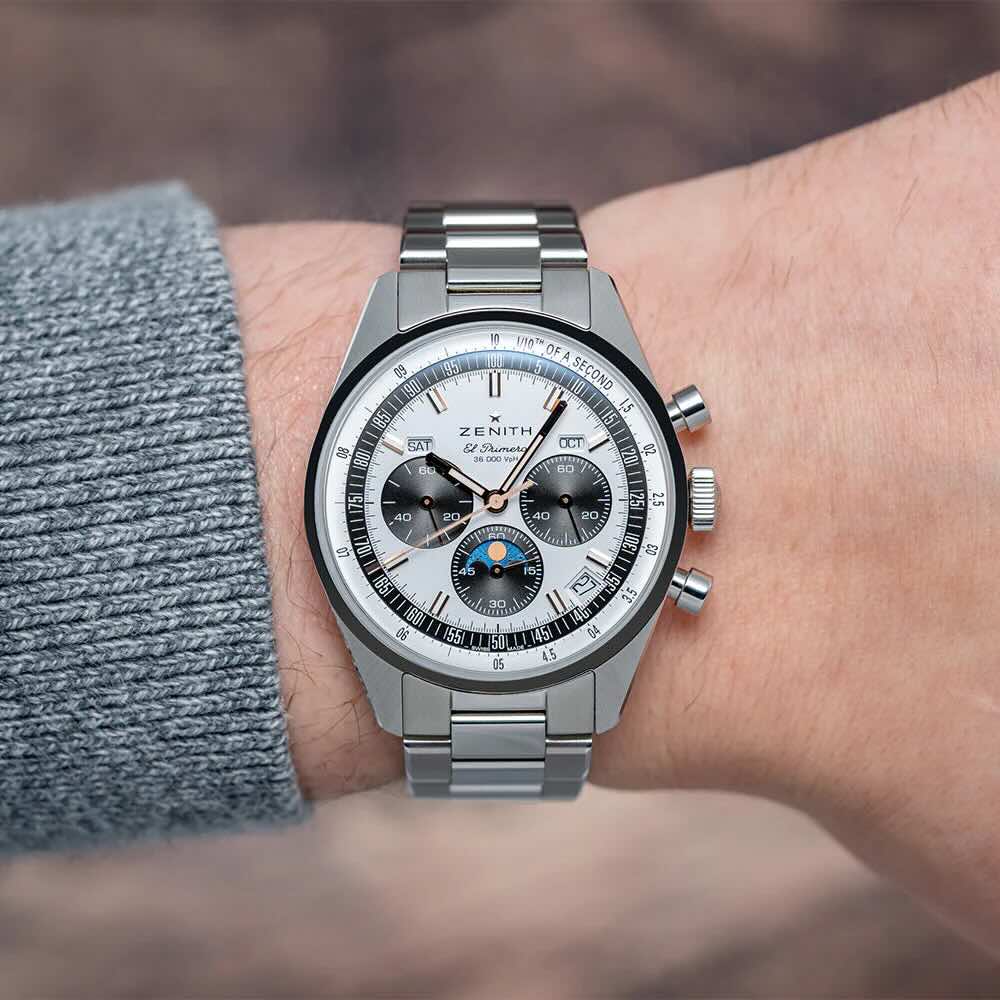
The Zenith A384 measures 37mm in diameter with a 47mm lug-to-lug and sits at about 12.6mm in height. It sounds small, but it uses a tonneau (or barrel-shaped) case that makes it blocky and angular. It also features sharp facets that catch the light. Because of that chunky geometry and the flat, broad lug structure, it wears with a ton of presence and commands attention without needing to sit on the wrist like a hockey puck.

For those with slender wrists, finding a modern chronograph that doesn't look completely disproportionate is a perpetual struggle, and usually, you have to compromise between getting a cool complication and actually being able to fit your watch under a shirt cuff. The A384’s 37mm footprint is basically the holy grail of proportion because it sits perfectly flush, providing the all-important 1970s tool-watch aesthetic. Better yet, purists can breathe a sigh of relief: Zenith’s Revival series hasn't touched the original dimensions one bit. The watchmaker actually laser-scanned the original 1969 pieces and dug up the historical blueprints to re-create the case down to the micron. As a result, the A384 variants feature beautiful, radial-brushed finishes on the top surfaces, contrasted by high-polished bevels running down the flanks. Add in those vintage-style pump pushers, and you have an almost identical reproduction of the original El Primero.
The Engine: El Primero Caliber 400
We have to do a little geeking out over the El Primero movement, because the modern A384 Revival models are powered by the El Primero Caliber 400 — a fully integrated chronograph featuring a traditional column wheel and a horizontal clutch. It beats at 36,000 vibrations per hour (most modern mechanical watches tick away at 28,800 vibrations per hour), giving it a buttery-smooth, stutter-free sweep of the seconds hand. The watch can also accurately measure elapsed time down to 1/10th of a second.

Operating at 5Hz requires an immense amount of energy, putting incredible stress on the escapement. Back in 1969, Zenith even had to invent a special dry lubricant (molybdenum disulfide) just to keep the escapement teeth from tearing themselves apart at those speeds. The modern Caliber 400 benefits from decades of refinement and Zenith’s tighter manufacturing tolerances. It can deliver a 50-hour power reserve and still maintain the exact architecture of its 1969 ancestor.
It’s easy to dismiss "high-beat" as just marketing language, but a 5Hz (36,000 vph) movement acts like a higher "sampling rate" for time, not just a smoother hand sweep. It makes the watch more resilient to external shocks because the balance wheel is moving faster and can recover much quicker from the odd jolt. It also helps mitigate "positional error,” so when gravity pulls on the balance wheel, the 5Hz movement helps average out these influences better than a standard movement.

If it weren’t for a rebellious watchmaker named Charles Vermot, however, the El Primero movement wouldn’t have survived. During the quartz crisis in the mid-’70s, the owner of Zenith decided that mechanical watches were dead. He ordered all the El Primero tooling, presses, and blueprints to be sold for scrap metal. Luckily, Vermot, who worked at Zenith at the time, secretly hid everything in a walled-off attic at the Le Locle manufacture and meticulously cataloged everything. Years later, when mechanical chronographs made a comeback, Zenith was able to resurrect the El Primero practically overnight.
The Gay Frères Ladder Bracelet
If you really want the full vintage experience of the Zenith Chronomaster A384, you have to look at the bracelet that Zenith developed in collaboration with bracelet manufacturer Gay Frères back in the late 1960s. The ladder bracelet is unique in that it bears wide-open gaps between the links instead of featuring solid center links. Back in the day, this was marketed as a sporty, breathable option for active wearers, but today it just looks incredibly cool and vintage.

The ladder bracelet is designed to drape over the wrist beautifully, offering a tactile experience you don't often get from standard, heavier modern bracelets. Critics sometimes argue it feels a bit light or "chintzy" compared to the heavy milled clasps of modern steel sports watches, but that lightness is the entire point, especially since the modern version now comes equipped with a fold-over clasp featuring micro-adjustments for added convenience and comfort.
The Purist's Choice: Chronomaster Revival A384

If you want the truest expression of the original 1969 model, you look at the standard Zenith Chronomaster Revival A384 (Reference 03.A384.400/21.M384). It has the classic "panda" dial: a crisp, stark white lacquered base accented by pitch-black chronograph subdials and a black outer tachymeter scale. Zenith absolutely nailed the details here. The central chronograph seconds hand is painted a vibrant, glossy red that pops, and the hour markers are rhodium-plated, faceted, and filled with Super-LumiNova to match the baton hands. A massive point of contention for some watch enthusiasts demanding symmetry in a watch is the date window at 4:30, but historically, this is exactly where it belongs on an El Primero.
The Brown-Dial Alternative: Chronomaster Revival A384 'Tropical'
Before we delve into the Brown Dial A384 let's do a quick primer on "tropical" dials. Back in the day, certain dials had a paint defect that caused them to fade from black to a warm, chocolate brown after years of exposure to sun and humidity. Collectors absolutely love these aging effects, paying huge premiums for what is essentially a factory flaw turned legendary. Zenith looked at its archives, found some beautifully aged original A384S, and thought “Why not?”

The Zenith Chronomaster Revival A384 Tropical (Reference 03.A384.400/69.M384) is the chocolate panda of the pack, featuring a rich warm tone applied to the three registers, this time against a warmer, creamier main dial. To really sell the vintage illusion, the lume on the faceted hour markers and hands is a tinted beige, often referred to as "Old Radium" Super-LumiNova. Faux patina gets a lot of grief in the watch community. Get it wrong, and it looks cartoonish and cheap. But Zenith pulls it off with unbelievable restraint, creating an interplay between the warm cream dial and the chocolate brown registers. Pair it with the industrial steel of the angular case, and the brown “Tropical” A384 variant is arguably one of the most visually arresting of all.
(One quick note for clarity: As you explore the Revival lineup, you’ll probably encounter the A385. Don't confuse it with the brown-dial A384 "Tropical." These are two different watches; the A385 uses the exact same case but features a smoked brown gradient dial – a historically accurate model in its own right, and equally stunning.)
Cult Classics: Expanding the A384 Universe
The beauty of the A384 case is that it acts as a phenomenal blank canvas. While the standard and tropical models lean heavily into history, Zenith has also used this shape to have a little fun.
The Chronomaster Revival Shadow

If you love the geometry of the A384 but want something stealthier, you need to look at the "Shadow" edition, because this is where Zenith takes the watch’s 37mm case blueprint and ditches the stainless steel in favor of microblasted titanium, giving it a matte, dark grey, almost military aesthetic that absorbs light rather than reflecting it.
The dial also abandons the contrasting registers entirely, opting for a sleek, matte black base and grey subdials. Crucially, there’s no date window, which completely changes the personality of the watch. It feels more like a piece of modern tactical gear rather than a dose of 1969 retro. Plus, because it’s titanium, it weighs practically nothing on the ladder bracelet.
The Lupin The Third Editions

Back in the 1970s, the popular Japanese anime Lupin the Third featured a character named Daisuke Jigen, and in the very first episode, Jigen is clearly wearing a Zenith A384. But the animators took some creative liberties and drew the dial with colors that Zenith didn't actually produce (an all-black dial with gilt accents and panda dials with unique subdial configurations). Fifty years later, Zenith proved to the world it didn’t take itself too seriously by producing some actual watches in these configurations.
Vintage vs. Revival: The Buying Experience
If you find yourself captivated by the A384 design, you’ll no doubt be debating whether to go down the vintage route and buy an original 1969 model or stick with a modern Revival model. Though there is an undeniable allure to owning the real deal from 1969, the vintage El Primero does require deep pockets and even deeper patience. You have to consider the possibility of replaced service parts and over-polished cases, which reduce the watch’s value, as well as a movement that might desperately need a costly overhaul.

The Revival series, frankly, makes more sense because Zenith has executed these reissues so faithfully that you’re getting true 1969 aesthetics, but with sapphire crystals on the front and back (as opposed to the acrylic crystals and closed casebacks of the originals), along with modern Super-LumiNova and a movement built with modern lubricants and tighter tolerances.
At a retail price hovering around $8,500 on the steel ladder bracelet (or $8,200 on the leather strap), the Zenith Chronomaster Revival A384 sits in a highly competitive bracket. For this price, you’re getting a vertically integrated, in-house, high-frequency chronograph from a brand with unimpeachable historical pedigree.
The Final Verdict
Whether you opt for the purist white-and-black panda, the warm, nostalgic "Tropical" brown dial, or something stealthier like the Shadow, you’re strapping a piece of watchmaking history to your wrist when you buy the Zenith A384. But let’s look past the heritage for a second. The real gain here is that a pure mechanical pedigree and perfect proportions will always win out, no matter the age or provenance of the collection. Zenith could have easily upsized the case or modernized the dial to appease modern trends, but it didn't. As such, it remains one of the few wearable chronographs on the market that you can actually wear every single day.


Be the first to leave a comment
Log in or to leave a comment