




Short on Time
The Origin Story: Foundation in Aviation
Helmut Sinn, the founder and namesake of Sinn, had an interesting life long before he ever decided to make watches. He was born in Metz, a town on the banks of the Moselle and Seiille Rivers, in 1916, just two years before it was lost by Germany to France at the end of the Franco-Prussian War. Trained as a pilot in the years leading up to World War II, Sinn flew missions over Europe during the war, earning the nickname “Helmut the Arrow.” His piloting career was cut short when he crashed his Junkers Ju 88 in Soviet Russia, sustaining severe back injuries and losing two fingers. After the war, a career as a flight instructor, and a brief stint selling cuckoo clocks to American soldiers stationed in Germany, Sinn embraced his affinity for precision mechanics and founded Helmut Sinn Spezialuhren in Frankfurt in 1961.

Initially, the company’s focus was on the needs of aviators — not surprisingly, considering its founder’s background. In its first decade or so, Sinn made cockpit clocks, navigation timekeepers, and chronograph wristwatches for pilots — all built to Helmut Sinn’s own in-house specifications and assembled at the company’s headquarters in Frankfurt-am-Main in Germany, initially using largely Swiss-made parts. Sinn sold directly to customers, including military units, establishing the business model that the brand still follows today.
The Sinn/Breitling Connection

Like much of the rest of the watch industry, Sinn’s fortunes in the 1970s and ‘80s were affected by the introduction of quartz technology and the disruptive effect it had on traditional watchmaking. In Sinn’s case, however, the most consequential results on its business were second-hand. Breitling, the Swiss watchmaker most associated with aviation watches, fell upon hard times during this “Quartz Crisis” era, and that company’s management sold the rights to its most emblematic and popular timepiece, the Navitimer, to Sinn and another firm called Sicura. However, only Sicura also acquired the rights to the model’s name; Sinn, which owned the technical plans as well as hundreds of stock parts — including cases and dials — released its version of the Navitimer in 1979, calling it simply by the reference number 903. The watch housed the Lemania Caliber 1873 and, on its exterior, was virtually a dead ringer for Breitling’s 1952 model, with a tricompax dial layout, beaded bidirectional bezel, and logarithmic circular slide-rule scale, the navigational tool that made it so appealing to the era’s long-haul pilots.
A Space Milestone: Sinn Chronograph 140 S

Sinn remained largely unknown to civilian watch enthusiasts for the first several decades of its existence. That began to change In 1985, when a German physicist, Professor Reinhold Furrer, wore a Sinn 140 S wristwatch into space as part of the D-1 spacelab mission. For many years, this watch was believed to be the first automatic chronograph wristwatch in space (preceded by Breitling’s Navitimer, Omega’s Speedmaster “Moonwatch,” and a handful of others, all with manually wound movements), but it was actually the second, behind the Japanese-made Seiko “Pogue,” worn by the astronaut for whom it’s nicknamed over a decade earlier, in the 1973-’74 Skylab 4 mission. Nevertheless, the Sinn 140 S, which at the time contained a Swiss-made Lemania 5100 movement, gained renown for proving that a self-winding wristwatch, despite its dependence on gravitational pull, could keep reliable time in the zero-gravity environment of a space capsule.

Sinn revived the history-making watch as the ST 140 Space Chronograph in 2012, with a 44mm bead-blasted steel cushion case, an internal rotating pilot’s bezel operated by a crown, and an ETA/Valjoux 7750 chronograph caliber replacing the discontinued Lemania. The re-edition was also enhanced with a host of the proprietary technologies described below, under the purview of Lothar Schmidt, who ushered in the modern era of Sinn, starting in 1994.
Expansion and New Technologies: Enter Lothar Schmidt

Schmidt was a German engineer and businessman who had spearheaded notable technical achievements for Switzerland’s IWC and assisted in the reconstitution of German high-horology house A. Lange & Söhne. He took over ownership of Sinn from its founder, then 78, renamed the company “Sinn Spezialuhren,” and built upon its aviation-centric roots to forge it into a brand that pushed the boundaries of technical innovation and over-engineered toughness.

The first major innovation was the introduction of the Ar-Dehumidifying Technology in 1995, which debuted inside the Sinn 203 Ti-Ar, a titanium-cased dive watch. This system utilizes three key elements, starting with filling the interior of the case with an inert gas, originally argon (that’s the “Ar”), then adding a copper sulfate capsule that absorbs moisture, and finally sealing the case with Extreme Diffusion Resistance (EDR) gaskets, which block atmospheric moisture better than standard rubber gaskets and resist aging and cracking. This combination helps reduce the aging of oils inside the movement, protects the crystal from fogging in extreme temperatures, and extends service intervals overall. The drying capsule is replaceable, and can be monitored via a small aperture in the case or dial. In 1998, Sinn added its own proprietary lubricant to the Ar-Dehumidifying system that resisted viscosity breakdown and aging in extreme cold or heat; watches with this robust Temperature Resistance Technology are able to function mechanically in atmospheres ranging from –45°C to +80°C (–49°F to 176°F).

Sinn, under Schmidt’s leadership, continued to optimize its watches for use in extreme environments. The company’s Diapal technology, first applied to a movement in 1995, is designed to make a watch’s inner mechanisms practically lubrication-free by using diamond crystals for the pallet forks instead of the more traditional synthetic rubies. The HYDRO technology, first applied to a watch in 1996, made the company’s dive watches even more resilient by filling the entire watch, including the dial, hands, and movement, is filled with a crystal clear synthetic fluid in a vacuum; by eliminating any presence of air inside the watch, it becomes impervious to water pressure. More recently, in 2017, Sinn launched its [Q]-Technology, for quartz watches like the ladies’ 434 models (example above), which shields the quartz movement from electromagnetic interference inside a sheath made of a proprietary alloy.
The First Mission Timers: Sinn's EZM Concept

On the heels of its dehumidifying technology came the first watches in Sinn’s EZM series, whose initials are derived from the German word Einsatzzeitmesser, or “mission timepieces.” Aptly named, the EZM models are designed for specific professional “missions,” aimed not only at pilots and divers but also firefighters, medics, and special German military and law enforcement units. The original EZM 1, for example, was a titanium-cased chronograph with a Lemania movement and a left-handed crown, designed for the special needs of Germany’s tactical police units. The EZM 3 was a 500-meter water-resistant steel watch for divers; the EZM 12, designed for helicoptering medics, had a unique pulse-counting inner bezel and a strap system that could be used for chemical sterilization; and the recently released EZM 19 is engineered for special military units, with its mission-timing bezel scale built around four-hour operational blocks and a 35-minute briefing period.

Another technology strongly associated with Sinn watches emerged in 2003. The Tegiment hardening process developed by the brand, and applied to the German submarine steel that it now regularly uses for watch cases, is different from standard plating or coating in that it is a thermal-chemical process that hardens the outer layer of the metal itself, rendering it more resistant to scratching, abrasion, and corrosion. By way of comparison, standard stainless steel measures around 220 on the Vickers hardness scale while Tegimented steel weighs in at about 1,200 Vickers. Tegiment steel made its debut on the 756 Duochronograph (above) and can be found on many of the brand’s timepieces today.
Highlights of the Modern Collection
Sinn 6000 Frankfurt Financial District Watch

While it was growing its appeal to wearers doing dirty or even dangerous jobs, Sinn eventually extended its reach to white-collar professionals with the introduction of the Frankfurt Financial District watches in 1999. The original 6000 model, a 38.5mm chronograph, was conceived to celebrate Frankfurt, Germany, as Europe’s financial capital, and it was the first Sinn model expressly designed as a dress watch for businessmen. That watch proved to be the foundation of a series that the brand still produces today, recognized for its elegant dimensions, its array of useful complications for globetrotting executives, like calendars and multiple time zone tracking, and its movements’ signature rotors, with a stylized engraving of the Frankfurt skyline.
Sinn U1 and U2 Series

In 2005, Sinn introduced one of its toughest and most emblematic tool watches, the U1, and its GMT-equipped counterpart, the U2. Both watches were notable for the material that they ushered into watchmaking for the first time: German “U-Boat” (aka Submarine) steel, sourced from the global shipbuilding company Thyssen-Marine Systems. Stainless steel alloys used for watch cases are generally not engineered for long-term resistance to the corrosive effects of seawater, but these watches’ 44mm cases are forged from the same highly seawater-resistant alloy used in the hulls of submarines, which also has the benefit of being highly antimagnetic and which takes well to Sinn’s Tegiment hardening process. U1 and U2 watches are recognizable for their highly legible black dials, with white and red details; their hardened rotating dive-scale bezel, held securely in place by a special ball-mounting mechanism; and their screwed 4 o’clock crown, which helps achieve a rare water-resistance rating of 1,000 meters (2,000 meters in the GMT-equipped U2).
Sinn 556 Series

With the Sinn 556, introduced in 2008, Sinn proved that it can also excel at an understated, less-is-more style of timepiece without sacrificing the brand’s signature robust character. Combining a utilitarian, military-inspired aesthetic with subtle elegance, the Sinn 556 I features an eminently readable dial housed in a versatile 38.5mm case, paired with a classic steel H-link bracelet. True to Sinn’s reputation for over-engineered toughness, the watch is constructed from surgical-grade stainless steel with a signature satin-brasted matte finish, incorporating a screw-down crown that ensures water resistance to 200 meters. A sapphire crystal caseback offers a view of the self-winding Swiss Sellita SW200 movement, which operates with a 38-hour power reserve.
Sinn 857 UTC TESTAF

Sinn established its own criteria for its aviation-centric tool watches, called TESTAF (Technischer Standard Fliegeruhren), in 2012. Those attributes — which are arrived at by testing each watch in multiple areas of not only functionality but external stress resistance — are on display in the GMT-equipped 857 UTC TESTAF, in a 43mm, Tegiment-hardened, stainless steel case. Two wide hands on the black dial show the local hour and minute on large white Arabic numerals while a smaller openworked orange hand points to another time zone on a corresponding orange 24-hour scale positioned inside the main hour and minute ring. The Swiss-made ETA 2893-2 caliber is secured inside a 43-mm case that resists water pressure to 200 meters and also includes the proprietary anti-fogging Ar-Dehumidifying technology for the crystal, shielding it from extreme cold conditions. One year after the TESTAF models launched, Sinn releases a special “LH Cargo” limited edition — 777 pieces celebrating the introduction of the Boeing 777F to the fleet of Germany’s Lufthansa Airlines.
Sinn 104 St Sa

Sinn leaned into a more “everyday” style of multipurpose tool watch with the introduction of the Sinn 104 in 2013. The initial model had a classic black dial, and its follow-up in 2017 introduced a crowd-pleasing white dial. Housed in a 41mm steel case, the 104 combines elements of both aviation and diving: its ratcheting bezel is bidirectional, with a countdown scale, and its dashboard-clock-inspired dial features an orientation triangle at 12 o’clock, a day-date complication at 3 o’clock, and a set of luminous-coated skyscraper hands. The watch is outfitted with an automatic Swiss-made Sellita movement, which is visible behind a sapphire caseback window, and despite its outward simplicity, it’s another example of Sinn’s clever proprietary technology at work: the bezel is designed in Sinn’s “captive” style, in which it is screwed directly into the case rather than attached by a standard snap-in or friction-fitted ring, rendering it next to impossible for an impact to jar loose.
Sinn 856 B-Uhr Edition

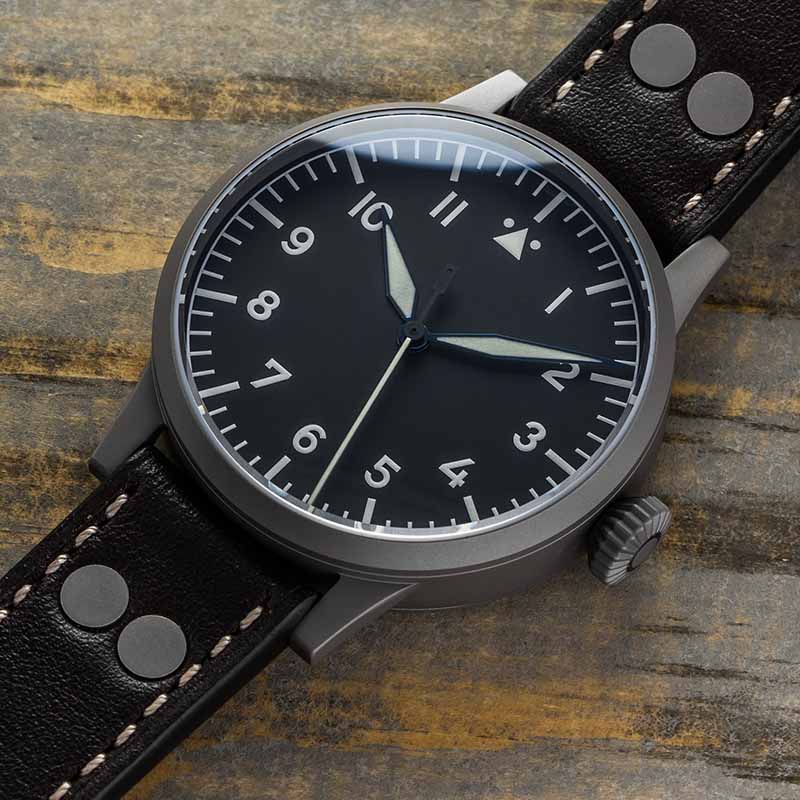
Even though so much of Sinn’s distinctive DNA is derived from its technical innovations from the 1990s and early 21st Century, the Frankfurt-based brand has also been known to pay tribute to its roots in wartime pilot’s watches and early aviation instruments. The 856 B-Uhr, for example, a limited edition released in 2016, evokes the early 1940s “flieger” watches for which it’s aptly named. (Click here to learn more about these historical pieces.) The 40mm steel case is extra-hardened in the proprietary Tegiment process; the historically influenced dial (with a 60-minute track that combines Arabic numerals and bar indexes, plus an inner 12-hour ring) is protected under a sapphire crystal enhanced against fogging by the Ar-Dehumidifying system; and the movement, a heavily modified Swiss Sellita automatic, is shielded from magnetic interference up to 80,000 A/m thanks to the case’s soft-iron inner-core structure. The 856 B-Uhr is offered on either a vintage-look two-layer leather strap or a steel bracelet with the same bead-blasted finish as the case for a more modern look.
Helmut Sinn lived to the ripe old age of 101, finally passing away in 2018, but his legacy of innovation and pushing at the frontiers of watchmaking technology lives on. Just one year after Sinn’s death, Lothar Schmidt marked 25 years at the company, and in 2021, the Sinn 104 St Sa pilot watch copped the prestigious German Design Award for “Excellent Product Design.” With Schmidt still at the helm, and a growing international fan base, the brand from Frankfurt continues to carve out its own performance-oriented niche in a watch industry too often dominated by style over substance. You can learn more at sinn.de




Be the first to leave a comment
Log in or to leave a comment