




Citizen Watch Co. has been in business since 1930, and has been responsible for several watch-industry milestones, including Japan’s first waterproof watch and the first watch with a titanium case. But here in the 21st Century, to most of us, the story of Citizen is really synonymous with the story of Eco-Drive, the game-changing light-powered movement technology that traces its history to 1976. If you’re doing the math, you realize that means, here in 2026, that it’s been 50 years, a full half-century, since the first Eco-Drive calibers arrived. And if you know anything about Citizen, you also probably realize that there’s no way such an anniversary would pass without both a major celebration and a significant technical advancement that takes the proprietary technology to the next level.

That technical advancement is embodied in an intriguing new timepiece called the Citizen Photon (above), which I explore in detail below. Read on to discover why the Photon, unveiled back in March in New York City and available at retail as of this Fall, is being referred to as the Ultimate Eco-Drive Watch.
The Evolution of Eco-Drive

Before Eco-Drive came quartz. The first quartz-powered movements arrived in 1969 and throughout the ensuing decades, this new technology — which made watches more accurate and less expensive than those with traditional mechanical movements — would transform the watch industry. Citizen began installing quartz movements in its watches around 1973, but right from the start the company was determined to make such movements even more efficient and user-friendly with a proprietary technology of its own. In 1976, Citizen introduced the Quartz Crystron Solar Cell (above), the first watch with a quartz movement whose rechargeable battery could be powered by any light source, from natural sunlight to a lamp on a nightstand. The battery life of the analog-digital Crystron was very low, so Citizen continued upgrading the light-charging technology, releasing a watch in 1986 that could run on a single charge of light for eight days and another in 1995 that ran for six months on a single charge. It took another decade for Citizen’s determined engineers to mold these early efforts into the Eco-Drive system as we now know it.

The first Citizen Eco-Drive watches, powered by the Caliber 7878, were launched in 1996, equipped with the groundbreaking technology that is still at the heart of the Eco-Drive movements today: light passes through a translucent dial with a solar cell mounted directly underneath it, which supplies power to the lithium ion battery of the movement below. From an environmental standpoint, this also means the wearer almost never needs to discard old batteries and replace them with new ones. Eco-Drive has become the tentpole technology around which Citizen has built much of its modern collection, and Citizen continues to improve upon its Eco-Drive calibers in the 21st Century.
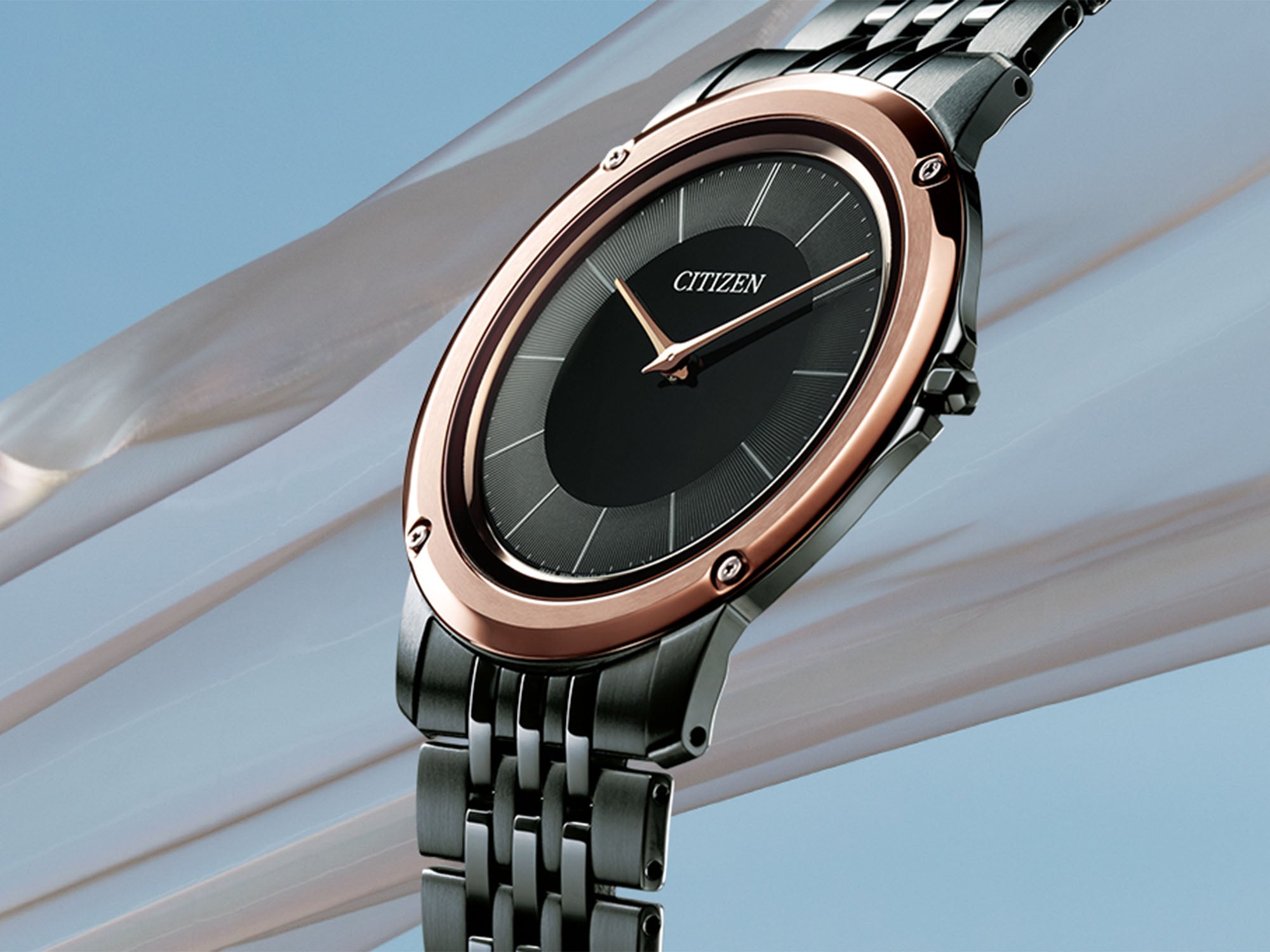
Eco-Drive turned 40 years old in 2016, and Citizen marked the anniversary with the launch of a new watch called Eco-Drive One (above), which at the time of its release was the thinnest light-powered analog watch in the world. Its case, made of a ceramic composite material called cermet, is 38.15mm in diameter and just 2.98 mm thick. Its Eco-Drive movement, which Citizen says required a total redesign of the original, comes in at just 1.00 mm thick and still claims an accuracy of +/-15 seconds per month. The movement also consumed less energy than its thicker predecessors, enabling the watch to run for 10 months on a single full charge from any light source.
The Photon Breakthrough

For its 50th anniversary in 2026, the company unveiled a new movement, Caliber E036, whose fully light-charged power reserve can run for 365 days, a full calendar year, introducing it in two limited-edition watches bearing the appropriate name “Photon,” a reference to the quantum unit of light energy. In contrast to the milestone for accuracy achieved by the Eco-Drive One, this evolution of Eco-Drive focuses on efficiency: the Photon will run for a full year — 365 days — on a single charge of light.
Case and Bracelet

The Citizen Photon case is very distinctive from those of other Citizen watches, with a rounded octagonal shape that integrates cleanly into a supple, gently tapered bracelet. Measuring a very wearable 39.6mm in diameter and 9.9mm thick, the case is made from Citizen’s proprietary Super Titanium, an alloy that’s five times harder than stainless steel — thanks to a special ion diffusion process in combination with the brand’s proprietary Duracect surface-hardening technology — while also being 40 percent lighter. Citizen has created two variations of this case, one in a pure metallic silver color, aka “Duratect Titanium Carbide,” and the other with a black-and-gold execution, which is a material marriage of black DLC coating and a Duratect amber yellow treatment on the base metal. Both are water-resistant to 5 Bar, or 50 meters.
Structured Dial and Hands

The Citizen Photon’s “structural color” dials are not only widely different from anything Citizen has used in a watch before; they are also as vital a component as the movement in defining the watch’s high-tech character. The dial is composed of two layered metal plates with ripple-like apertures, in a design inspired by a scientific experiment called “double slit.” Light passes through the slits and activates a layer of “structural color” film layer underneath, not only charging the movement but creating an ever-changing array of reflections and hues. In the “structural color” phenomenon, which Citizen re-creates here with the aid of its partners at Japan’s FujiFilm, the colors are produced not by a traditional use of pigments but by varying microscopic surface textures that reflect light.

The time is displayed on simple, luminous-coated baton hands and applied index markers, all set under a dual spherical sapphire crystal with double antireflective coating. The seconds hand of the Duratect Titanium Carbide model (Ref. BJ6560-53W) is in bright yellow for contrast against the dial, while the Duratect DLC/Amber Yellow model (Ref. BJ6569-59X) uses purple coloring for this hand.
Optimized Eco-Drive Movement

Once it’s fully charged via the light passing through the multi-layered dial and structured film, Citizen’s new Eco-Drive Caliber E036 not only boasts the year-long power supply noted above but an accuracy of +/- 15 seconds per month. In general, this new movement represents a different philosophy from the one that underpinned the Eco-Drive One movement; the latter offers the same level of monthly precision as the Photon movement but its focus was on achieving record-breaking wafer thinness rather than guaranteeing a full year’s power reserve. An Eco-Drive One, according to Citizen, will run somewhere between 10 months and one full year on a single charge, which is still longer than a standard Eco-Drive caliber’s usual six to seven months. But the Photon’s Caliber E036 (if I’m understanding the distinction accurately) is the first Eco-Drive movement that is guaranteed to run for a full year when fully charged. Citizen even overhauled the circuit system of the core movement so that it can drive a heavier handset without losing additional power. And while the front of the movement is shrouded by the gridlike structure of the dial plates and their underlying layer of film, the back of it is totally hidden by the solid titanium caseback, which is engraved with an Eco-Drive 50th Anniversary logo and the watch’s individual limited edition number.
Limitation and Pricing

Yes, at least in the case of these two inaugural editions, the Citizen Photon is a limited edition, with each of the models being produced in a run of 5,000 pieces. The silver-colored Ref. BJ6560-53W retails for $995 and the black-and-gold Ref. BJ6569-59X is priced at $1,195. Citizen refers to the Photon, and its movement, as “the new Eco-Drive standard,” so it follows that we’ll be seeing the use of this 365-day light-powered caliber, and perhaps the complex structured dial design, on other models throughout the brand’s vast collection in the future. You can learn more at citizenwatch.com




Be the first to leave a comment
Log in or to leave a comment