




Short on Time
If the modern success story of Tudor can be attributed to the launch of one distinct collection, it is, undoubtedly, the Black Bay. Like any intelligent watch brand, Tudor has taken that success and run with it full speed ahead, riffing and launching distinct extensions and sub-collections within the Black Bay universe that, at this point, are designed to meet the wants and needs of just about every enthusiast out there. Today, I’m going to be putting two distinct lines within the Black Bay family head-to-head that are, to the untrained eye, quite similar, but take on the vintage-revival theme in two distinct directions: the Black Bay 54 and the Black Bay 58. Down below, I’ll get into the nitty-gritty of what these two members of the larger Black Bay family have in common, and the intricacies that, together, have profound effects on what they deliver. After our short and sweet history lesson, I’ll be diving right into the key details of the Tudor Black Bay 54 vs. 58, all while interjecting my own musings and philosophies on how to approach these subtle differences.
Tudor Black Bay Context

As always, I’m going to keep the history lesson as concise here as I can, but if you have a bit more time, I’d recommend checking out this complete guide to the Tudor Black Bay. Anywho, the story of the modern Black Bay begins at Baselworld in 2012 (initially dubbed the “Heritage Black Bay”). After years of struggling in the shadows of the Crown and leaving the U.S. market entirely, Tudor’s comeback was nothing short of extraordinary. The sporty, vintage-inspired diver identity of the Black Bay at the time was right on the pulse of what the growing watch enthusiast wanted. Received with open arms, the Black Bay was the product that could finally get Tudor out from under the thumb of Rolex and stand confidently on its own.

After years of refining the larger Black Bay identity, including adding its own manufacture movement in 2015, Tudor launched the Black Bay 58 in 2018. Yet again, the brand was met with resounding applause, and the Black Bay 58 became an overnight hit. Compared to the standard collection, the Black Bay 58 introduced downsized case proportions that the audience was begging for. Measuring a versatile 39mm (vs. the 41mm-43mm of the standard Black Bay), the Black Bay 58 reimagined a specific, influential model from the brand’s legacy. The DNA of the Black Bay 58 is a modern remix of the 1958 Tudor Oyster Prince Submariner Ref. 7924 at its core, and it’s also where its “58” moniker comes in.

A key ingredient of the Black Bay 58’s success, other than its more versatile proportions, was the ways in which Tudor added its own, distinctive modern identity into the mix. The Black Bay 58 falls more into the vintage-homage category, rather than that of the 1:1 vintage reissue. The most notable details that play into this are the snowflake hand, which is now the modern Tudor calling card, along with the snowflake-tipped seconds hand. These small but impactful additions speak to the contemporary identity of Tudor, moving away from the Mercedes hour hand and lollipop-tipped seconds hand of the Oyster Prince Submariner reference 7924. In the years since, the Black Bay 58 has also become the vehicle for the brand to frequently experiment with different metals, like gold and bronze, as well as GMT functionality.

The Black Bay 54 officially entered the chat in 2023. A faithful reimagining of Tudor’s first diver, the 1954 Submariner ref. 7922, this addition to the Black Bay flagship family was a match made in heaven for those who wanted a diver that felt indistinguishable from vintage models. A large component of this boils down to sizing here. Continuing with the theme of downsizing, the Black Bay 54’s 37mm diameter and slimmed-down profile of 11.24mm felt even more aligned with the codes of 20th-century divers. For small-wristed folks like me, it also introduced even more reasonable proportions into the Black Bay universe. The dive bezel on the Black Bay 54 also looks remarkably more vintage, foregoing the single-minute gradations on other Black Bay models. In spite of its more petite frame, the Black Bay 54 also managed to pack in robust 200 meters of water resistance, which is often lost on smaller divers across the industry.
Case Comparison

As we’ve likely already been anticipating, the differences in the case department of the Black Bay 54 vs. the 58 largely boil down to a few millimeters. Since its introduction, the Black Bay 58 has maintained a 39mm diameter, even across the GMT takes on the line. For the classic Black Bay 58, we’re looking at a case profile of 11.9mm. The GMT does take up a little more wrist real estate, measuring 12.8mm thick. This is to be expected when you expand functionality. Both the classic diver and the dive GMT take on the Black Bay 58 maintain 200 meters of water resistance, as they should.
The Black Bay 54, on the other hand, is notably more petite. 37mm is spiritually more aligned with the smaller sizes that were typical throughout divers of the 20th century, which is a big part of what makes the line feel even more vintage-inspired than the BB58. We’re also looking at a much slimmer case profile at 11.2mm, which is always a win in my book. Recently, Tudor has downsized its BB54 even more and now offers a 34mm sizing option, specifically for its sparkling “Blue Lagoon” rendition. Personally, I would love to see Tudor move further into this direction and offer more minimalistic takes on the 34mm BB54.
 One key difference to note between the Black Bay 54 vs. 58 lies in the bracelet department. Though both have 20mm lug widths, the bracelet of the BB54 always features the brand’s T-fit clasp. Things get a little more dicey with the BB58. Models that have been introduced more recently have the easy adjustment T-Fit clasp system, but some of the older models, like the navy blue dial model, haven’t gotten that upgrade out of the box yet. Additionally, the rubber strap options for the BB54 are not as tapered as those of the BB58, and strike me as a touch less sophisticated.
Dial Comparison

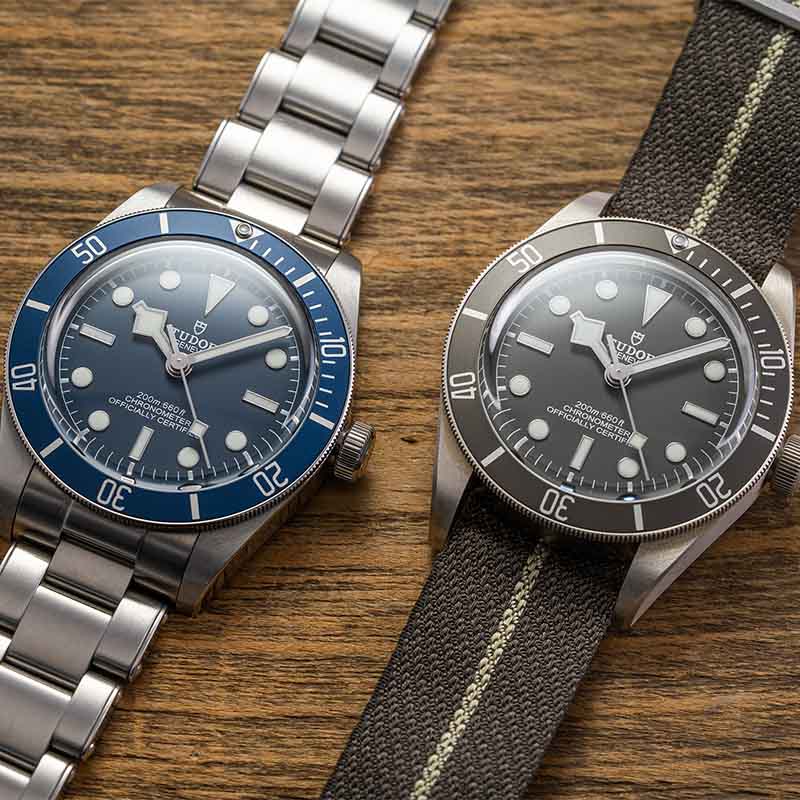
Though there are some slight differences in the bezels of the Black Bay 54 vs. 58, in the dial department, the key layout is basically a copy-and-paste situation. Across both models, you’ll find the Snowflake hour hand and sword-shaped minutes hand, mixed with a geometric menagerie of pips and bars marking the hours, along with the triangle marker at twelve. There are some quirks when it comes to the seconds hand, as the BB54 and newer BB58 models have switched to the lollipop-tipped seconds hand, whereas the older BB58 models still have the diamond-shaped tip.

Given that the Black Bay 54 is still in its youth, in terms of color and textural dial variations, you’re much more limited. Currently, there is just the black and gilt model holding down the fort, along with the shiny turquoise dial on the 34mm Lagoon Blue model. On the other hand, there’s been more time for Tudor to experiment with the Black Bay 58. In addition to the similar black and gilt treatment as the BB54, you’ve got blue, taupe, and most notably, the sunray burgundy model released earlier this year. For the yellow and bronze gold takes on the Black Bay 58, you also have a khaki green and brown dial to choose from.
The Movements

In the movement department of the Black Bay 54 vs 58, as a baseline, we’re all working within the realms of Tudor manufacture calibers. For the BB54 and the newer additions to the BB58 family, we’re working with the COSC-certified MT5400 and COSC and METAS-certified MT5400-U calibers, respectively. Interestingly, the MT5400 in the BB54 has a slightly more robust power reserve of 70 hours (vs. the 65-hour reserve of the MT5400-U).
Older variations of the BB58 are powered by the COSC-Certified MT5402 manufacture caliber with a 70-hour power reserve. In the case of any confusion you might face, always refer to the text at the bottom of the dial. For the METAS-certified calibers, it will always say “Master Chronometer,” earning this title from the more expanded testing the calibers are subjected to. Movements that are only COSC-Certified will instead read “Chronometer Officially Certified.”
Final Thoughts

Both certified hits in their own right, in the Black Bay 54 vs. the Black Bay 58 matchup, there is no clear winner. As with all watches, whether one is better than the other boils down to personal preferences. The BB58 has had more years to expand, riff, and experiment, but the BB54 has managed to deliver a more unisex-friendly, vintage-inspired diver in one quick hit so far (excluding the Blue Lagoon addition). So far, I think the BB58 has won the popular vote, but on a personal level, my preference is with the Black Bay 54, as it just wears better on me. Either way, I think we can expect the brand to keep the remixes on both lines coming. Maybe one day we’ll even see a GMT take on the Black Bay 54, but in the meantime, I would like to see more options available for the smallest Black Bay model family. You can learn more at tudorwatch.com
2 Comments
Log in or to leave a comment
Will be great a second release of the Pink Flamingo with Withe sub dials
Log in or to reply
Erin, fantastic article! You managed comprehensive, technical and still a fun read.
Log in or to reply