




Short on Time
The Citizen Promaster Diver “Fugu” is one of the most emblematic of the Japanese watchmaker’s vast and storied series of dive watches, and one of the few in that series to offer an automatic movement in addition to a time-tested and distinctly quirky design. Here’s what you should know about the watch — technically the Promaster Dive Automatic — and why it’s considered to be such a value proposition by so many dive watch enthusiasts.
A Bit of Citizen Dive Watch History

Citizen Watch Co. was not the first Japanese watchmaker to make a purpose-built watch for diving — that would be its main rival, Seiko, which introduced its famous 62MAS in 1965 — but Citizen made the first “water-resistant” Japanese watch six years earlier. The Citizen Parawater (above), on the market in 1959, was waterproof to 50 meters of depth, an impressive feat for the era, and it proved to be the forerunner of many even more robust Citizen dive watches to come. The first of these models came in the 1960s, but Citizen’s quest for dive-watch dominance kicked into high gear with the release of the Promaster Marine in 1982. (Citizen dive watches, despite their functional and stylistic diversity, all fall under the “Promaster” category today.) That same year, Citizen released its 1300m Professional Diver’s Watch, its first in a titanium case, which went into the record books as the most water-resistant watch in serial production at the time.
Citizen continued to innovate in the dive-watch space throughout the 1980s, the same era that gave rise to the manufacturer’s most important and identity-defining invention, the light-powered Eco-Drive movement. The first Citizen Aqualand debuted in 1985 as the first quartz diving watch with a digital depth gauge. Building upon that legacy, Citizen introduced the original “Fugu” dive watch in 1989, whose large bezel with alternating smooth and serrated edges made the watch’s case resemble the puffer fish that gave it its nickname (and later its actual model name). The launch of the Fugu marked the modern era of the Promaster family within the Citizen portfolio, which today consists of watches aimed at land, sea, and air professionals. Below, we take a deep dive (pardon the too-easy pun) into the Promaster “Fugu” and what makes it stand apart from the rest of the
Reviewing The Promaster Diver Fugu
Citizen Promaster Diver Fugu Case

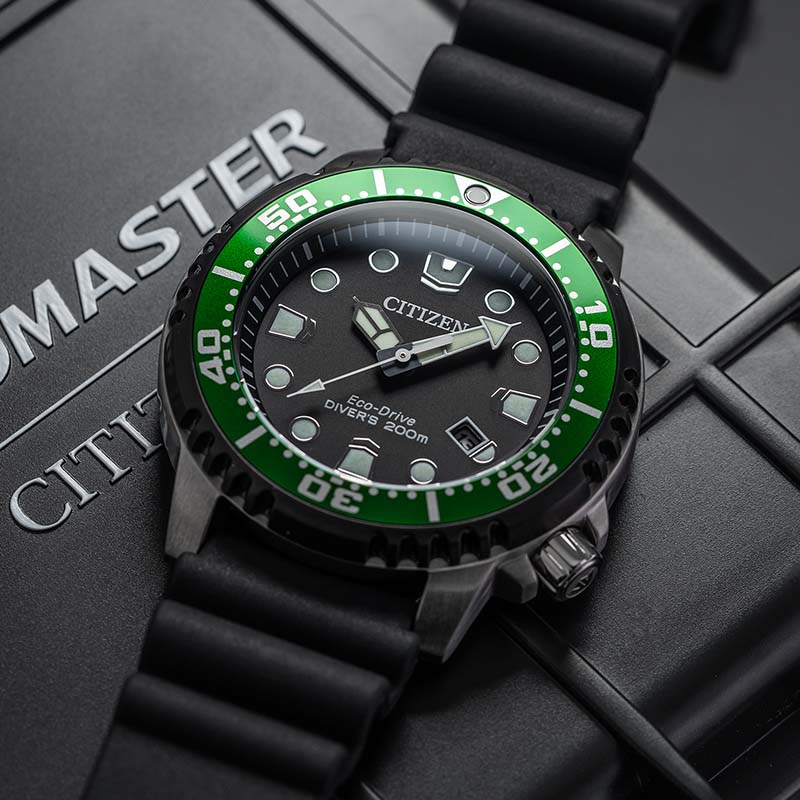
The three-part case of the “Fugu,” made of silver-toned stainless steel, measures 44mm in diameter and 11.6mm thick, with a lug to lug measurement around 48mm. It’s indisputably a large watch, but not in the same zip code as the most wrist-dominating monsters from the Eco-Drive side of the Promaster Dive series, like the “Orca” (46mm wide, 14.6mm thick) and “Eco-Zilla” (48mm wide, 18.5mm thick). As mentioned above, the Fugu’s unidirectionally rotating bezel, with a dive-scale insert color-matched to the dial, has that distinctive serrated edge that inspired its nickname. The design isn’t just for aesthetic interest, of course, but utilitarian in concept, offering a gritty surface that is easier for wet or gloved hands to grip and turn to set dive times. The screwed crown also helps ensure the watch’s professional-grade water resistance of 200 meters.
The crystal over the dial is made of sapphire that offers (in Citizen’s words) “superior scratch resistance and hardness.” A defining feature of the case, and one that helps set this model apart from other Citizen dive watches, is the use of a screw-down crown with a knurled texture, occupying the unusual position of 8 o’clock. Some reviewers I’ve read don’t care for this unconventional placement, but those who do cite the fact that it prevents the crown from poking into the small of the wrist — which would certainly be a concern while diving.
Citizen Promaster Diver Fugu Dial And Hands

Citizen clearly had underwater legibility at top of mind when it designed the Promaster Fugu dial, here photographed in its deep green iteration, which (as noted above) harmonizes with the bezel for a bold monochromatic look.. The hands and the hour indexes are wide and coated with bright-green-glowing lume for underwater legibility. The shorter hour hand is a variation on a classic cathedral style while the longer minute hand is a broad arrow that sweeps across the bottom edges of the markers. The seconds hand, here with a bright, contrasting red arrow tip, at 3 o’clock, serves to remind the wearer at a glance that the watch is running (again, very helpful if you’re actually diving.

The hour markers are primarily rhomboid-shaped, with additional inward-facing pointers at the quarter-hours. An exception is the very unusual 12 o’clock marker, which appears as sort of bulky, ”Y”-shaped mass, and which some of the more creative types in the watch-reviewing community have dubbed “underpants” (picture the shape flipped upside down). Whatever the marker makes you think of, it is distinctly geared for easy orientation underwater.
The other outlier on the hour and minute track is the day/date window at 3 o’clock, which accompanies a truncated version of the rhomboid hour marker to its right. The markers align with the printed, five-minute dots on the dial’s flange, and the 12 o’clock orientation index aligns with the luminous dot on the bezel when the bezel is set to its starting position (i.e., not being used to time a dive). The presence of the day and date information, while an identifying element of the Fugu Automatic models, may rankle some serious divers, who actually want to wear the watch underwater and who likely don’t care much what day of the week it is while they’re engaging in their hobby.
Citizen Promaster Diver Fugu Movement

Behind the solid caseback, which is laser-engraved with an illustration of a puffer fish (perhaps the most obvious sign that Citizen has embraced the nickname that the watch’s fans have tagged it with), is an automatic, mechanical movement, the Japanese-made Miyota 8204. It’s essentially an in-house movement, since Miyota is wholly owned by Citizen. To go a bit deeper, the movement hails from the 8200 family of self-winding mechanical movements that Miyota established back in the 1970s, possibly as a hedge against quartz movements falling out of fashion (Miyota, as one would expect of a Japanese movement manufacturer, makes both quartz and mechanical calibers).
It’s very similar to the predecessor Caliber 8203, differing only in the addition of a hacking seconds function that the former doesn’t have. It’s even more similar to the Caliber 8205, with the only distinction there being that the 8205 is sold to outside brands (including many microbrands) while the 8204 appears to be exclusive to Citizen. Caliber 8204, whose first iteration came all the way back in 1977, features 21 jewels, a unidirectional (clockwise) rotor for winding, a 21,600-vph frequency, and a power reserve of 42 hours — i.e., almost but not quite weekend-proof. The accuracy of Caliber 8204, a somewhat pedestrian -20/+40 seconds per day, won’t exactly give the Eco-Drive movements a run for their money but is to be expected for a mechanical movement at this very attractive price point.
Fugu vs. Fujitsubo
Citizen’s Promaster Dive lineup is extensive and varied, and the differences between the models is often fairly subtle. However, once we narrow down to only the watches with automatic movements — discounting all the models with Eco-Drive movements, including the huge “Orca” and “Eco-Zilla” as well as the analog-digital Aqualand family — the main alternative to the boldly aggressive Fugu divers are the watches in the more streamlined (and more widely wearable) “Fujitsubo” collection.

Also known as the “Challenge Diver,” the Fujitsubo (above, technically, the Promaster Mechanical Diver 200M) is the modern version of a 1977 watch that was lost in the ocean and recovered years later on Australia’s Long Beach Reef, still ticking and covered in barnacles. (“Fujitsubo” is Japanese for “barnacle.”) It’s smaller than the Fugu, at 41mm in diameter and 12.5mm thick, and most notably, its case is made of Citizen’s “Super Titanium” — a proprietary alloy prized for exceptional hardness and scratch-resistance, rather than stainless steel. The dial’s hour markers are wide and luminous, similar to those on the “Fugu” models, but the hands are notably different, particularly the "Mercedes”-style hour hand that calls to mind the one on Rolex’s famous Submariner. The font on the bezel is also different, a bit bolder and more angular. The crown is more conventionally positioned at 3 o’clock, and the window just to its left on the dial displays just the date numeral, not the day and date.
The Fujitsubo is, in summary, perhaps the go-to alternative if you want a self-winding Citizen dive watch but might be a bit intimidated by the larger dimensions and more in-your-face design elements of the Fugu. Of course, one wonders how long it might be before Citizen gives us a version of the latter in Super Titanium as well, which could start an entirely new conversation.
Variations and Pricing

It’s surely not an accident that the Citizen Promaster Fugu Automatic has been in the Japanese brand’s collection since the 1990s. It is in pretty much every respect a rugged, function-forward dive watch with some signature elements that set it stylishly apart from its brethren — whether we’re talking just the Citizen lineup or the larger universe of tool watches in this very attainable price segment. The green-dialed steel-bracelet model pictured here (Ref. NY0151-59X) has an MSRP of $625; a two-tone steel-and-gold version on a two-tone bracelet will run slightly higher, at $675, while a white-dialed model in a black PVD-coated steel case on a rubber strap is priced at $675. Another black PVD-coated model, on a bracelet with a full-lume dial, is priced at $725. You can discover the entire Promaster Dive collection at citizenwatch.com.


Be the first to leave a comment
Log in or to leave a comment